Showing posts with label guest post. Show all posts

Friday, December 2, 2016

The Nightmare Before Christmas

Editor's Note:  Holiday Film Reviews commences our most festive season with a guest post from Thalia Heinrich, a young writer and family friend based in Iowa.   You can follow her as @thalia.doris on Instagram. She has written a review of the 1993 stop motion classic "The Nightmare Before Christmas."  Many thanks for your contribution to Holiday Film Reviews, Thalia!  


Premiered October 29, 1993

The Nightmare Before Christmas is a movie many people enjoy. Originally a poem written by Tim Burton, it was released the 29th of October, 1993. This movie, good for any time of year, is still enjoyed to this day, 23 years after it was first released. I’d like to discuss why.

Jack tries his hand at making paper snowflakes.

The beginning of the movie introduces us to outrageous and unique characters in “This Is Halloween," a well-known song that is fun to sing along to.


Jack Skellington explores Christmas Town in disguise.
We are introduced to Jack Skellington, voiced by Chris Sarandon (speaking) and Danny Elfman (singing).


The animation in this movie is brilliant. It uses dazzling stop-motion animation. The animators put a lot of work into getting every detail to bring the characters to life, and they do a really good job. Their hard work is clear in the movie, where you can see all the emotion displayed through each character. Another amazing thing they do with this movie is the contrast between Halloween Town and Christmas Town. Halloween Town is very dull, almost black and white, and Christmas Town is very bright, colorful, and sparkly.


The music in this movie is outstanding. It’s all written by Danny Elfman, who also sings for Jack. The songs are amazing, recognizable, and fun to sing along to. The writing is great and the singing is brilliant. The music is just simply unforgettable and one of the things that makes this movie one of my and many others' favorite. I also love the characters so much. They are wonderfully written and beautifully voiced. Even the most minor of characters are filled with emotion and personality.


A little boy gets an unexpected holiday surprise from Santa-Jack!
Overall, this is a wonderful movie for any time of the year. Wonderful music by Danny Elfman, outstanding acting by people such as Cathrine O’ Hara and Ken Page, and gorgeous stop-motion animation all help bring this movie together, making it a simply amazing experience loved by many even 23 years after it first hit theaters.


If you’re looking for a fun thing to do with your friends, family, or even by yourself, a Nightmare Before Christmas singalong is certainly something fun everyone can enjoy.


Wednesday, December 24, 2014

The Muppet Christmas Carol


Holiday Film Reviews presents a special guest post from Victoria Willis,  a long time friend of mine and co-editor of  Geek Rock: An Exploration of Music and Subculture.  You can follow her as @Technopoesis  on Twitter.   Thanks very much, Vickie for sharing your review of  The Muppet Christmas Carol!    -- RigbyMel 

***************************************

I have a confession to make. I had never seen The Muppets Christmas Carol prior to watching it for this blog post.


I’ve seen other versions of A Christmas Carol.  Scrooged is a particular favorite. And, of course,  I love Charles Dickens’ novella. I love that it’s one of THE Christmas tales, and I love how it is essentially a ghost story. I love that it almost single-handedly revived (and created) traditions for a holiday that was a lot less warmly loved prior to 1843 than it is today. I love that it embodies Christmas spirit. And I love how it defines Christmas spirit and  how it emphasizes giving and charity and joyousness and community and fellowship. It’s not just that Charles Dickens is the man (cause he is), but he’s the man that’s pretty clearly against The Man, and A Christmas Carol is a lovely introduction to  Dickens’ many works.

So, I clearly went into The Muppets Christmas Carol with great expectations (ha ha ha).  How does The Muppets Christmas Carol hold up to such a scrumptious piece of literature?

Brilliantly.


First, in a twist, Dickens narrates the tale, as played by Gonzo the Great, with the help of Rizzo the Rat. They are excellent narrators, occasionally breaking the fourth wall and engaging in hi-jinks to follow the story that they are also telling. These are playful narrators, delighting in storytelling and stories at the same time; a process, really, that just underscores how creativity, and storytelling, isn't always linear.


Michael Caine is a formidable Ebenezer Scrooge. I hesitate to say that I prefer his Scrooge to Bill Murray’s, but I think I do. It’s a difficult role to play, Scrooge; it’s difficult to portray the embodiment of callousness and penny pinching and heartlessness. It’s certainly much harder to be callous and penny pinching and heartless to a bunch of adorable Muppets.  Caine’s “Humbugs” sound like what I hear when I read Dickens.


For Kermit the Frog, it’s not easy being mean, and he’s a fantastic Bob Crachit, gentle and kind and courageous.  Miss Piggy plays his wife, and her indignation is classic Piggy. With Robin the Frog as Tiny Tim, it’s a dynamic foundation for the Cratchit family, and a heart-wrenching one as well. Tiny Tim always gets me, and it’s easy to see how Scrooge’s heart is melted by this family.


The Ghosts of Christmas Past, Present, and Future are as weird, strange, and downright creepy as ghosts tend to be. 


The Ghost of Christmas Past is ethereal, young, and fleeting, and the effects actually hold up pretty well.


The Ghost of Christmas Present is stern in Dickens, but the jolly Muppets version infuses an almost Buddha (albeit a goofy Buddha) quality to the present.


And the Ghost of Christmas Future, who, while not a skeleton, is a cloaked figure so scary that Gonzo and Rizzo take a break from narrating to hide, and return later, after that ghost has departed. Each ghost does its duty, and shows Scrooge the things he needs to see.


There are a few things that make The Muppets Christmas Carol truly special. First, is how close it is to the original. For the most part, it’s unswerving. 


There are a couple of tweaks, such as the addition of Jacob Marley’s brother, Robert, to allow Statler and Waldorf to play the role(s). The Ghost of Christmas Present is upbeat and rather goofy, which is appropriate for the age of the intended audience. Second, surprisingly (to me, watching for the first time) is the music, which is genuinely sing-able and charming. It’s easy to forget just how endearing singing Muppets are, and how sing-able Muppets’ songs can be. And, third, of course, the Muppets themselves, whose shenanigans and comedy contribute to the story, and make it a wonderful introduction to this traditional Christmas tale for young audiences and less young audiences alike.


The Muppets Christmas Carol makes it easy to be a Scrooge. And by “Scrooge,” I mean, of course, a generous, grateful, joyous, merry, kind, attentive, compassionate kind of person. When all is said and done, what other kind of Scrooge is there?

A Grinch, on the other hand, well, that’s another matter entirely.


Wednesday, December 17, 2014

The Shirley Temple Show: "Babes In Toyland"

Thanks to Joanna Wilson of Christmas TV History for today's guest review.  Joanna has written multiple books about Christmas television and film. Any of her books would make a nice Christmas gift for holiday TV fans.  Her most recent book is called A  Is For Akron, an A to Z list of things to see & do in Akron, OH.  Joanna has been a friend and inspiration to this blog for years.


Yes - THAT Shirley Temple had a TV show! 
Christmas is certainly a time of nostalgia.  Most of us reflect back to simpler times, especially to our childhoods, when Christmas was still filled with fantasy, magic, and life lived at a slower pace.  With this in mind, I'd like to share about an often overlooked Christmas episode of the TV anthology series Shirley Temple's Storybook.  The 1960 episode "Babes in Toyland" was created during the second season after the series had changed its name to The Shirley Temple Show--but it's the same series.  Most installments of the family-friendly series were a re-telling of popular fairy tales or children's literary classics. "Babes in Toyland" however is an hour-long adaptation of the 1903 operetta by Victor Herbert.

In this 1960 episode, a now grown Shirley Temple introduces and narrates the story accompanied by her own children.
Left to right:  Charlie Black, Jr., Lori, and Linda Susan.
The 1960 TV adaptation is a comedy version of Babes in Toyland and is loaded with music and dancing.  The story is a familiar one--youngsters Alan and Jane are being looked after by their mean and nasty Uncle Barnaby who wants to cash-in on the children's generous inheritance.  Barnaby decides he desires their money sooner, rather than later, and hires three cutthroat thieves to set the innocent children adrift in a leaky boat.

Uncle Barnaby (Jonathan Winters) is a greedy, nasty man.  However, Winters' comedy style of mugging for the camera deflects a great deal of  what could potentially be a frightening story. 
The adventure story continues when the children survive the open seas and wash up on nearby shores.  Alan and Jane are discovered by the gypsy witch Floretta and find themselves among friends with the band of dancing gypsies. That is, until Floretta sells knowledge of the children's whereabouts to Uncle Barnaby.  Alan and Jane escape and run into the frightening Spider Forest, eventually entering Meantown.

Jane and Alan (foreground) arrive at the gypsy camp where there is much dancing and merrymaking.
Jane and Alan are jailed in Meantown, accused of the crimes of smiling, niceness, and kindness!
The nasty residents of Meantown find a way to jail the youngsters in the center of town.  Once again, Alan and Jane escape just one step ahead of Floretta, Uncle Barnaby, and his three bumbling henchmen.  The next stop on Alan and Jane's flight is the kingdom of Toyland, where all the toys for Christmas are made.  The children feel happy and safe amongst the land of the dancing toys and ask the royal Master Toymaker if they can stay forever.

To avoid being recognized by Uncle Barnaby, the children hide in plain sight as a dancing ballerina and wooden toy soldier during the Toyland Parade. 
The king likes the children, however Floretta, Uncle Barnaby, and his minions arrive in Toyland to take Alan and Jane back home.  In the end, the Master Toymaker and the gypsy witch stand up for the children and Uncle Barnaby's evil scheme is thwarted.

In the end, the cast gathers to sing "Toyland," the most recognizable and still popular song from the original operetta. 
You may already be familiar with other filmed adaptations of the operetta Babes in Toyland.  The most noteworthy include the 1934 movie starring comedians Laurel & Hardy which has since been re-issued under the title March of the Wooden Soldiers. Walt Disney created his own version in 1961 starring Annette Funicello and Tommy Sands. Let's not forget the surreal 1986 TV movie version starring Drew Barrymore and Keanu Reeves. And, in 1997 an animated version was created featuring the voice talents of Jim Belushi, Lacey Chabert, Christopher Plummer, and Charles Nelson Reilly.  Most of the adaptations alter the story quite a bit from the original plot.  However, I think the best adaptations are the ones that feature the original music by Victor Herbert and Glen MacDonough.

While imprisoned in Meantown, Jane sings "Go To Sleep, Slumber Deep,"  to her brother Alan,  another song from the operetta. 
Shirley Temple's "Babes in Toyland" features the best of the original Herbert compositions including "Toyland," "Go to Sleep, Slumber Deep," "I Can't Do the Sum," and "March of the Toys."  In addition to these familiar Babes in Toyland tunes, the 1960 episode features numerous shorter musical performances.  This is an asset in an hour long program which allows for more performances to be included while preventing slow, drawn out segments.  The program also squeezes in two major dance sequences--the gypsy camp scene and the Toyland parade at the end--which makes this Christmas TV variety program even more entertaining. 

Can you recognize Shirley Temple under the fake nose and chin, gray wig and kercheif, and long pointy finger nails?  She's Floretta, the gypsy witch.
Recognize these comedic actors' faces?  Left to right:Joe Besser, Jerry Colonna, Carle Ballantine.  Center is Jonathan Winters, of course.
Even if you're not already familiar with the music from Babes in Toyland, you will be impressed with the stellar ensemble cast in this 1960 musical comedy.  Not only does Hollywood icon Shirley Temple introduce and narrate this adventure story, but she also stars in it as Floretta, the fortune-telling gypsy witch.  The evil Uncle Barnaby is played by Jonathan Winters.  The three bumbling cutthroats--Gonzales, Gonzorgo, and Rodrigo--are played by Jerry Colonna, Carl Ballantine, and Joe Besser, respectively.  And, the children, Alan and Jane, are played by Michel Petit and Angela Cartwright.

Jane and Alan lost in the Spider Forest.  Jane is played by actress Angela Cartwright, who was also on The Danny Thomas Show in 1960.  Later, she would appear in the TV series Lost In Space--and sing in the movie musical The Sound Of Music.
An added bonus--keen viewers may be able to spot animatronic fantasy figures--just like the kind that used to fill department store window displays at Christmas time--in the background of the Toyland scenes.
In addition to the music, dancing, and amazing cast, I think 1960's Babes in Toyland has something else going for it. The production was staged live which means the camera captures the authentic performances as they occur--and a few unpredictable moments as well. For example, the boat scene includes Petit nearly knocking over the ship's mast to which he is bound.  You can also see the boom microphone above the actors' heads in several shots. Although the camera moves a bit more slowly than we are used to, and the sets are often flat backdrops, I'm still caught up in the fantasy and adventure of the storytelling and music.  I love the more simple production values of this 1960 TV episode.  The lack of CGI elements isn't a weakness but rather its strength--a reminder of simpler times when entertainment included the viewers' imagination.  At Christmas time when I want to feel nostalgic, it's comforting to watch a program that also makes me feel nostalgic for quality Christmas entertainment.

Yes--Babes in Toyland is available for viewing on DVD.


Thursday, October 30, 2014

Nothing Ever Happens on Halloween: A "Buffy the Vampire Slayer" Marathon (Guest post!)

Holiday Film Reviews presents a special Halloween guest post courtesy of Victoria Willis, co-editor of the recently published book Geek Rock: An Exploration of Music and Subculture.  She also happens to be an old friend of RigbyMel's (they've known each other since elementary school) and a talented photographer and essayist.    We hope you enjoy this essay about the Halloween episodes of Buffy the Vampire Slayer.  - RigbyMel & J.A. Morris

*****************************************************

I’ve discovered that it’s impossible for me to write about Buffy the Vampire Slayer without making some sort of argument. This is probably largely due to my involvement in the Whedon Studies Association, a fantastic organization devoted to scholarship about all things Whedon-y. So if you enjoy (and/or disagree) with anything that you read here, check them out. And if you’re planning to marathon the Buffy Halloween episodes, then know that you are automatically awesome, and have chosen your Halloween activities wisely. The Halloween episodes are excellent. They are also easily marathon-able, with three Halloween episodes in Buffy (discussed in more detail below) and one Halloween episode in Angel (which I’m not discussing below, because even though it’s in the Buffyverse, it’s in Angel, not Buffy. But in case you’re wondering which episode it is, it’s “Life of the Party,” Season 5, episode 5.). Viewed together, these episodes create an interesting statement about identity, masks, and the mundane. After all, nothing is supposed to happen on Halloween in the Buffyverse. 


Each Halloween episode of Buffy is, appropriately enough, about masks. Keeping up appearances.Saving face.Whistling in the dark. While it’s hard to say conclusively how the tradition of Halloween evolved, it is fairly clear that masks, candy, and carved pumpkins are central to the holiday. Whether the masks and disguises were to ward off the dead, protect against the dead, celebrate the dead, remember the dead, or ridicule the dead and/or death, the tradition of dressing up has continued, only now with costume contests and prizes. As Buffy tells Willow in “Halloween” (Season 2, Episode 6), wearing a costume is a chance to “come as you aren’t.” Buffy also points out that, for women in particular, Halloween is the opportunity for a woman to dress as sexy as she pleases without repercussion (an observation that is particularly interesting (and ahead of it’s time) in light of current discussions about slut-shaming). Willow dresses sexy, but loses her nerve and covers her sexy outfit with a ghost costume.


In this episode, we first meet Ethan Rayne, worshipper of Chaos and Giles’s former demon-raising chum. Ethan opens a costume shop in Sunnydale and sells enchanted costumes (he likes to sell enchanted things, evidently. See: “Band Candy”). Buffy, who has been lamenting that she is not an ordinary girl/ fancy noblewoman that Angel would have liked, buys a ballgown from Ethan’s shop and gets her wish. Willow’s ghost costume, also from Ethan’s shop, kills her and she becomes an actual ghost (wearing her sexy outfit that was underneath her ghost costume). Xander becomes an army guy because he bought a toy gun from the shop. 


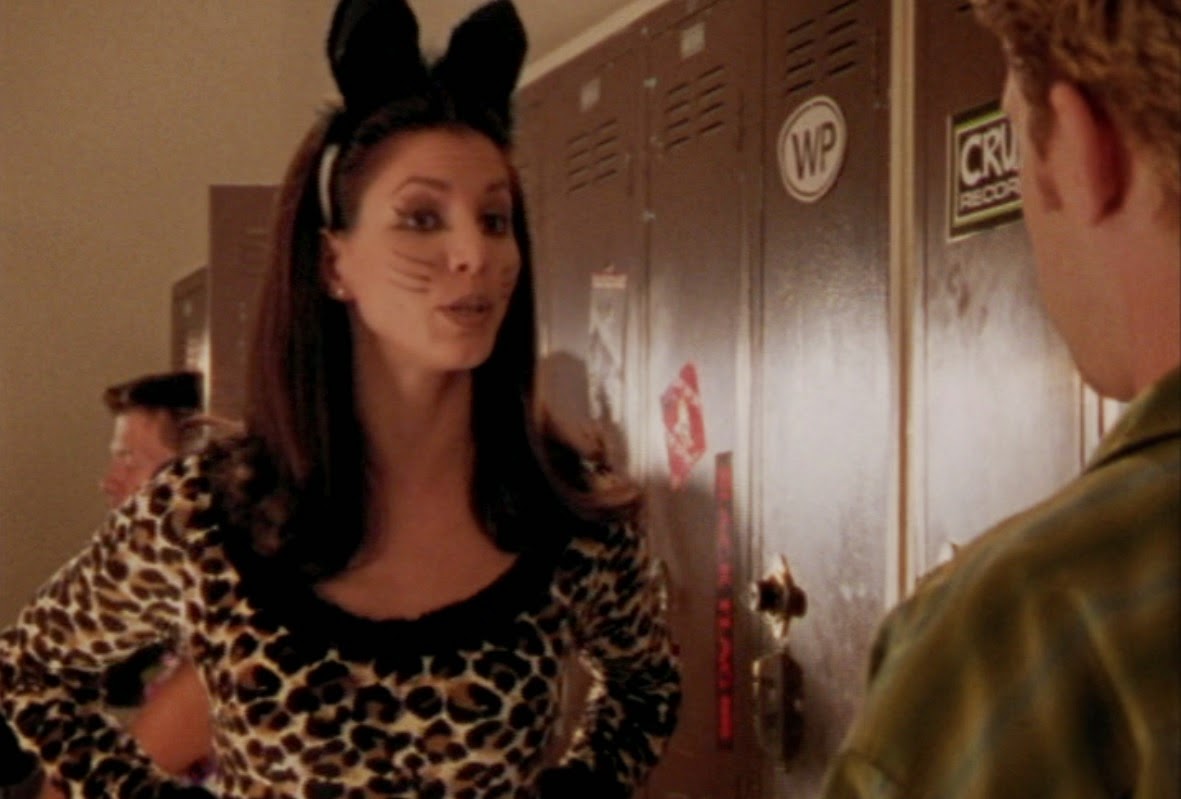
In “Halloween,” the enchanted costumes allow the wearer to become who they are. Cordelia, whose cat costume was purchased elsewhere, is already a catty character, mocking the uncool and priding herself on her dating skills. Cordelia is what she is, a point that continues to be made throughout the series. But the others are still negotiating their teenage identities, trying on activities and interests, much like one tries on costumes, in order to become what, and who, they are. When Willow dies and becomes her ghost costume, Giles looks at her sexy outfit and asks, stuttering a bit, “The ghost of what, exactly?” Even as Willow becomes what she is, who she is remains in question. But for identity negotiation, neither costumes nor teenagedom is required. Giles’ identity also comes into question when he confronts Ethan Rayne to break the spell, and the viewer learns that the tweedy librarian is not only connected to a sketchy, Chaos loving sorcerer, but is also quite the badass.


In the second Halloween episode, “Fear Itself” (Season 4, episode 4), Buffy and the Scoobies head to a frat party where the fear demon Gachnar has been brought forth. The fears of everyone in the house, including Buffy and the Scoobies, are made manifest. Buffy is alone. Xander is invisible to his friends. Willow can’t control her magic. Oz wolfs out. The only ones who are “immune” are Anya and Giles. Arriving late to the party, Anya discovers that the door to the frat house is missing. She is dressed as her greatest fear, a bunny, but her fear of losing Xander propels her to Giles. In another unexpected moment of badassery, Giles chainsaws his way into the frat house. They both run upstairs, find Buffy, Xander, Willow, and Oz, and Giles begins to explain how to defeat Gachnar. Buffy destroys the Mark of Gachnar, mistakenly bringing forth the fear demon, who, as it turns out, is tiny and squashable. 


“Fear, Itself” follows the same pattern of identity negotiation as “Halloween.” Anya and Giles are never affected by the haunted frat house. Somewhat like Cordelia, Anya’s identity negotiation is different from the other Scoobies. After all, she is a thousand year old ex-vengeance demon. She is trying not only to discover who she is as a teen, but also who she is as a human. The other Scoobies are trying to deal with their fears, and with how they compensate and react to their fears. Their fears are teenage fears, superpowers notwithstanding: the fear of being unimportant and lesser than one’s friends, the fear of being alone, the fear of losing control. And these fears don’t really ever go away as we grow up. Giles, the adult, is still negotiating his identity. He keeps his chainsaw hidden, but reveals it when necessary. He’s learning how to be an ex-librarian just as much as Anya is learning how to be an ex-demon. His fears, and Anya’s fears, are much like the fears of the Scoobies--being unimportant, unwanted, out of control, and alone. Fear is human. And we  learn to cope with our fears, much like Buffy and the Scoobies do: by wearing costumes, keeping our chainsaws in our gym bags, seeing our fears for what they are, and squashing them as best we can.


Giles creates a door into the frat house
We wear costumes every day. We put on work clothes, we put on brave faces, we put our best foot forward. Identity is not just about who we are, but about how we are. “All the Way” (Season 6, Episode 6) is the final Halloween episode in Buffy. The episode opens with a Halloween sale at the Magic Box. Xander and Anya are in costume, spirits are high, and Xander finally announces to the rest of the Scoobies that he and Anya are engaged. Willow uses magic to decorate Buffy’s house for an engagement party, which upsets Tara, who says Willow’s magic usage is getting out of control (and which is, incidentally, Willow’s manifested fear in “Fear, Itself”). Dawn goes out with Janice under the guise of spending the night at Janice’s house. Together, Dawn and Janice meet up with Zack and Justin, two boys from school. Dawn, trying to impress the boys, smashes an old man’s pumpkin. Her pumpkin smashing is fairly outside of the Dawn norm, and her action is her attempt to be someone the boys, particularly Justin, will like and find cool. Her identity negotiation has become more teen than paranormal (see “Blood Ties” for the Key to paranormal identity negotiation). The boys that she tries to impress, however, turn out to be vampires. The teen vamps, like all vamps, wear masks of humanity, and Dawn has to see through the mask and stake her first kiss. This is how coming of age works in Buffy. Appearances are stripped away. Because masks, costumes, appearances--these things are important for how negotiate ourselves and the world around us.  


Dawn dusts her first kiss
And, much like Halloween in the Buffyverse,  these negotiations are important and also, at the same time, nothing terribly special. Nothing ever happens on Halloween that doesn’t happen on any other day. We put on our work costumes. We ask for rewards. We negotiate who we are, in small ways and large ways. We squash our fears and get on with our lives as best we can. In the Halloween episodes of Buffy (and, arguably, the series as a whole), the real magic is in the allegory of becoming who we are. In the case of the Halloween episodes, it’s spookier magic, with added treats. 


Monday, December 16, 2013

Bewitched: "Humbug Not To Be Spoken Here"

Thanks to Joanna Wilson for today's guest review.  Joanna runs the HollyAndIvyTastic blog Christmas TV History and has authored several books about Christmas television programs and films.  These books make great gifts at Christmas or any time of year.     


The fourth season episode "Humbug Not to Be Spoken Here" on Bewitched is the second of a total of four Christmas episodes made during the series' run.  This particular episode has some common story elements with the other Bewitched Christmas episodes, and I fear that its legacy has been overlooked.  Maybe I can convince you to take another look at this under-appreciated magical Christmas installment--that includes a much imitated Dickensian spin.

"Christmas is just another day to me," says a Scrooge-like Mr. Mortimer.
In 1967's "Humbug Not to Be Spoken Here," Darrin Stephens finds himself being asked to work late into the night on Christmas Eve--although he's already promised to help his wife Samantha decorate the Christmas tree.

Working late on Christmas Eve, the insensitive Mr. Mortimer obligates his butler Hawkins to continue serving as well.
A new client, the very business-minded Mr. Mortimer is insisting that the details of his advertising campaign can't wait until after the holidays.  When Darrin refuses to work any later, Mortimer follows him to the Stephens' home insisting Darrin continue working or he'll cancel his $500,000 account.

"There's a time for soup and there's also a time for sugar plums!"  Darrin insists that Mortimer's instant soup business can wait.
Later that evening, Darrin tries on his Santa costume he'll use in the morning for his daughter Tabitha.  Meanwhile, Sam speculates on what's wrong with Mortimer.
Sam feels badly for Mortimer and his lack of holiday spirit.  She's sure there's something she can do to reach him and she hatches a plan to inspire Mortimer's belief in Santa Claus.  While Darrin is sleeping in bed, Sam decides to use her magic to take Mortimer on a nighttime journey.

"Think of me as the Spirit of Christmas," says Sam as she awakens Mortimer on Christmas Eve.

There's no Polar Express here--Mortimer is going to take a ride on a witch's broom to the North Pole!
Sam flies into Mortimer's window and awakens him from his bed.  She confesses she's a witch and explains to the angry and confused man that she's taking him on a journey to the North Pole to introduce him to the real Santa Claus.

With the elves feverishly working in the foreground,  Mr. Mortimer is unimpressed when he meets Santa Claus (background).
At the North Pole, Mortimer is confused and upset and demands to be taken home.  Santa Claus agrees to drop Mortimer off at home when he passes by on his annual trip around the world.  On this long journey with Santa, Mortimer recognizes the home of his butler Hawkins.

Sam and Mortimer see Hawkins dancing around his Christmas tree.
Looking through the front window of Hawkins' home, Sam and Mortimer notice how happy the put-upon butler behaves when he's with his own family.  Mortimer remarks that he's surprised about Hawkins' happiness given that his employee doesn't have much money.

Character actor Charles Lane plays Mr. Mortimer.  Lane made himself a career out of playing curmudgeons
On Christmas morning, Sam, Darrin, and Tabitha are celebrating Christmas together and opening their gifts when there's a knock on the front door.  It's Mr. Mortimer who explains that he experienced a horrible nightmare last night and has had a change of heart about cancelling his ad campaign.  Sam goes along with his nightmare theory--pretending she doesn't know about his experiences last night.

Darrin in his Santa suit, Sam and Mr. Mortimer--all happy on Christmas morning.
Mr. Mortimer would like to continue working with Darrin after the holidays are over.  He'll have to wait until his butler returns anyway--he sent Hawkins and his family away on an all-expenses paid vacation.  The implication is that Mortimer now appreciates that money can't buy happiness and he regrets punishing Darrin for putting his family first before business.  When Mortimer sees Tabitha under the Christmas tree playing with a one-of-a-kind doll he saw at the North Pole, he's no longer sure what he experienced last night was a nightmare after all.

What sort of Christmas magic occurred last night after all?
What stands out to me in this holiday episode--despite the distracting Santa Claus and North Pole elements--is that this story is structured like an adaptation of Charles Dickens' A Christmas Carol.  Mortimer is focused on the importance of money, he has a lack of holiday spirit, he demands Darrin work on Christmas, and on Christmas Eve while in bed Mortimer is visited by a guide calling herself "The Spirit of Christmas."   For many of us, Santa Claus represents our belief in Christmases past.  Mortimer also visits a Christmas in the present--when he witnesses Hawkins' joy with his family.  And, Mortimer feels transformed by his night time journey, deciding to give gifts to those he's wronged and righting the future for his ad campaign.  The episode's story is a little muddy, but I believe Dickens' original elements are all clearly here.

Is Sam behaving arrogantly by taking it upon herself to teach Mortimer a life lesson?  Probably.  But we love Samantha anyway.
What makes this episode different from typical adaptations of Dickens' A Christmas Carol is that Samantha stands in for the three spirits of Christmases past, present, and future.  Even more precisely, she takes it upon herself to teach Mr. Mortimer a lesson about the holiday spirit by gaslighting him into thinking he's experiencing a supernatural journey during the night of Christmas Eve.  Well, Mortimer is taking a supernatural journey--by way of her witchy magic.  However, instead of a ghostly Jacob Marley character who wants to warn Scrooge about his upcoming painful fate in the afterlife--Sam decides she knows better for Mr. Mortimer and takes it upon herself to teach him a lesson about life.  It's actually kind of arrogant of Sam--but we'll forgive our favorite TV witch, this once!  I think the TV writers found an interesting and clever way to incorporate the much-beloved storyline of A Christmas Carol into this series without turning Sam (or any of the other regular characters) into the vilified Scrooge character.

Bo, Daisy, and Luke Duke each take a turn speaking across the top of the jug to create a spooky voice transmitted on the CB radio, hoping to scare Boss Hogg into transforming his life on Christmas.
I point out this interesting A Christmas Carol story development because I've seen it many times.  As someone who writes about Christmas entertainment, I've seen quite a few television versions of A Christmas Carol where the series' hero takes it upon him/or herself to gaslight an adversary into learning a lesson, usually inspiring the Christmas spirit.  Do you remember any stories like this?  How about the Six Million Dollar Man's 1976 episode "A Bionic Christmas Carol?"  It's also an element within The Dukes of Hazzard's 1980 episode "The Great Santa Claus Chase."  And, it has been done on the 1984 Christmas episode of Highway to Heaven, the 1996 holiday episode of Xena: Warrior Princess, and the 2009 Christmas episode of It's Always Sunny in Philadelphia, among others.  There are more episodes to add to this list--can you name one?

Col. Steve Austin disguises himself as Santa Claus and shows his adversary visions of his Christmas past, present and future on The Six Million Dollar Man.
I chose to share this particular episode of Bewitched and discuss this unique television spin on Dickens' original tale because I believe this 1967 episode is the first of its kind.  Do you know of an earlier example than this 1967 episode of someone being gaslit into receiving the Dickens treatment?  Let's discuss it.