Showing posts with label Tiny Tim. Show all posts

Wednesday, December 24, 2014

The Muppet Christmas Carol


Holiday Film Reviews presents a special guest post from Victoria Willis,  a long time friend of mine and co-editor of  Geek Rock: An Exploration of Music and Subculture.  You can follow her as @Technopoesis  on Twitter.   Thanks very much, Vickie for sharing your review of  The Muppet Christmas Carol!    -- RigbyMel 

***************************************

I have a confession to make. I had never seen The Muppets Christmas Carol prior to watching it for this blog post.


I’ve seen other versions of A Christmas Carol.  Scrooged is a particular favorite. And, of course,  I love Charles Dickens’ novella. I love that it’s one of THE Christmas tales, and I love how it is essentially a ghost story. I love that it almost single-handedly revived (and created) traditions for a holiday that was a lot less warmly loved prior to 1843 than it is today. I love that it embodies Christmas spirit. And I love how it defines Christmas spirit and  how it emphasizes giving and charity and joyousness and community and fellowship. It’s not just that Charles Dickens is the man (cause he is), but he’s the man that’s pretty clearly against The Man, and A Christmas Carol is a lovely introduction to  Dickens’ many works.

So, I clearly went into The Muppets Christmas Carol with great expectations (ha ha ha).  How does The Muppets Christmas Carol hold up to such a scrumptious piece of literature?

Brilliantly.


First, in a twist, Dickens narrates the tale, as played by Gonzo the Great, with the help of Rizzo the Rat. They are excellent narrators, occasionally breaking the fourth wall and engaging in hi-jinks to follow the story that they are also telling. These are playful narrators, delighting in storytelling and stories at the same time; a process, really, that just underscores how creativity, and storytelling, isn't always linear.


Michael Caine is a formidable Ebenezer Scrooge. I hesitate to say that I prefer his Scrooge to Bill Murray’s, but I think I do. It’s a difficult role to play, Scrooge; it’s difficult to portray the embodiment of callousness and penny pinching and heartlessness. It’s certainly much harder to be callous and penny pinching and heartless to a bunch of adorable Muppets.  Caine’s “Humbugs” sound like what I hear when I read Dickens.


For Kermit the Frog, it’s not easy being mean, and he’s a fantastic Bob Crachit, gentle and kind and courageous.  Miss Piggy plays his wife, and her indignation is classic Piggy. With Robin the Frog as Tiny Tim, it’s a dynamic foundation for the Cratchit family, and a heart-wrenching one as well. Tiny Tim always gets me, and it’s easy to see how Scrooge’s heart is melted by this family.


The Ghosts of Christmas Past, Present, and Future are as weird, strange, and downright creepy as ghosts tend to be. 


The Ghost of Christmas Past is ethereal, young, and fleeting, and the effects actually hold up pretty well.


The Ghost of Christmas Present is stern in Dickens, but the jolly Muppets version infuses an almost Buddha (albeit a goofy Buddha) quality to the present.


And the Ghost of Christmas Future, who, while not a skeleton, is a cloaked figure so scary that Gonzo and Rizzo take a break from narrating to hide, and return later, after that ghost has departed. Each ghost does its duty, and shows Scrooge the things he needs to see.


There are a few things that make The Muppets Christmas Carol truly special. First, is how close it is to the original. For the most part, it’s unswerving. 


There are a couple of tweaks, such as the addition of Jacob Marley’s brother, Robert, to allow Statler and Waldorf to play the role(s). The Ghost of Christmas Present is upbeat and rather goofy, which is appropriate for the age of the intended audience. Second, surprisingly (to me, watching for the first time) is the music, which is genuinely sing-able and charming. It’s easy to forget just how endearing singing Muppets are, and how sing-able Muppets’ songs can be. And, third, of course, the Muppets themselves, whose shenanigans and comedy contribute to the story, and make it a wonderful introduction to this traditional Christmas tale for young audiences and less young audiences alike.


The Muppets Christmas Carol makes it easy to be a Scrooge. And by “Scrooge,” I mean, of course, a generous, grateful, joyous, merry, kind, attentive, compassionate kind of person. When all is said and done, what other kind of Scrooge is there?

A Grinch, on the other hand, well, that’s another matter entirely.


Sunday, December 22, 2013

Scrooge (1951)

UK release poster.

Premiered October 31, 1951


This film was released in the U.S. as A Christmas Carol, here's the lobby card.
We now blog about the film that most critics call the best of all adaptations of A Christmas Carol.
But even this version is an not entirely faithful adaptation of Dickens' novel.  

Alastair Sim stars as Scrooge.  


Bob Cratchit is played by Mervyn Jones.


What are the major differences in this adaptation?


The film opens in the London Exchange instead of Scrooge's counting house.  He interacts with some businessmen, telling them that "Christmas has a habit of keeping men from doing business."  Outside the exchange, he encounters a man named Samuel Wilkins (Clifford Mollison), who owes Scrooge 20 pounds he cannot pay.  If Scrooge doesn't give him more time, Wilkins' and his wife will go to debtors' prison.  Scrooge dismisses Wilkins.  This makes Scrooge here arguably even meaner than he is in Dickens' story!


When Scrooge's nephew Fred (Brian Worth) visits the counting house, he doesn't give his usual speech about Christmas.  Scrooge also doesn't get to the utter his usual line about Christmas celebrants needed be boiled in their own pudding with a stake of holly through their hearts.  His interaction with Scrooge is short, followed by a separate visit to Cratchit. 


Michael Hordern as Jacob Marley
During Marley's ghostly visit to Scrooge, we are shown the tormented spirits wandering the earth trying in vain to help living folk.   This scene shows up occasionally in filmed adaptations, but rarely. 


The biggest change in this version is that it fleshes out Scrooge's backstory during the Christmas Past segment.   


Scrooge with the Ghost of Christmas Past (Michael Dolan). 
During Scrooge's time working as apprentice to Fezziwig (Roddy Hughes), a businessman named Jorkin (Jack Warner), who does NOT appear in Dickens' story (or in any other adaptation) tries to buy Fezziwig's business.  Jorkin tries to get Scrooge to poach Scrooge away from Fezziwig by offering him a bigger salary. 

Fan (Carol Marsh) comes to bring Young Scrooge (George Cole) home from school
We also see Scrooge's sister, Fan's death.  Ebenezer is heartbroken, insisting she's going to get well as he walks out. Because of being with the Ghost of Christmas Past, Scrooge learns that Fan wanted him to take care of Fred when she is gone.   As we saw in the opening,  he hasn't done a very good job of this.


Fan's death inspires young Scrooge to accept Jorkin's offer to clerk for him.  He meets Marley, who is already a clerk in Jorkin's business.  Scrooge speaks to Marley about his feeling that the world is "becoming a very hard and cruel place" and that he does not want to be crushed like "the weak and the infirm."  Marley and Scrooge realize they have much in common.  They eventually engineer a hostile takeover of Fezziwig's business.  Scrooge appears to feel  a bit guilty about this, but he refuses to talk to Fezzwig.  Later still, Jorkin is accused of embezzling funds from the company which allows Scrooge and Marley seize control of it.    

In a parallel scene to Fan's death,  Scrooge visits Marley on his deathbed - another scene that does not appear in the book or other adaptations.  Marley tells him they were wrong, but there's still time for Scrooge to save himself.  Once again, young Scrooge doesn't really listen to what the dying person asks of him.  


Scrooge signing Marley's death register
Scrooge's fiancee is named Alice. (Most adaptations call her Belle. Curiously, Dickens doesn't give her a name at all!)  When they discuss money, Scrooge says he loves Alice "because she's poor,not proud and foolish."  Of course, he changes his tune later and loses Alice as a result.  


Young Ebenezer and Alice at Fezziwig's party

When the Ghost of Christmas Present (Francis De Wolff) arrives,  along with the usual visit to the Cratchit's and Fred's homes that we expect,  we actually get to glimpse a scene with coal miners singing  carols around a fire.


Singing carols around the fire in a mining camp
This is part of Dickens' description of Scrooge's journey with the Spirit that rarely makes it into filmed adaptations. 


The Ghost of Christmas Present also shows Scrooge Ignorance and Want.  This is something that's in the book, but not often depicted in film and tv adaptations.

Ignorance and Want.
And in another new addition to the story, Scrooge observes Alice providing services to the poor during "Christmas Present".  

We also get a bit more of Scrooge interacting with Mrs. Dilber (Kathleen Harrison) the housekeeper in this version than is typical.  


J.A. Morris says: 

I've always believed that adaptations of this story are only as good as their Scrooge.  Sim has long been considered the best Scrooge and I have to agree.  Some actors play Scrooge as a mustache-twirling cartoonish villain.  But in Sim's hands, Scrooge is always human, we can relate to him even when we detest what comes out of his mouth.  This makes his nastiness more believable.  


Scrooge in a set that is lit like film noir
I'm not bothered by the expanded backstory.  Every adaptation omits portions of the story or adds new ones.  It would have been fine without the new stuff, but it doesn't detract from Dickens' story.


The rest of the actors are fine in their roles as well.  It's worth noting that two actors are well known to anyone who watched tv and film over the last 40-odd years.  The young Marley is played by Patrick MacNee, best known for portraying John Steed on The Avengers.  And Hermione Baddeley (best remembered for roles in Mary Poppins and Maude) plays Mrs. Cratchit.  Fans of Maude might appreciate seeing what "Mrs. Naugatuck" looked like when she was young. 

Hermione Baddeley as Mrs. Cratchit.

More than 60 years later, Sim remains the best Scrooge and this is still the best adaptation.  

J.A. Morris' rating:


4 candy canes!

RigbyMel says: 

This is a great adaptation of Dickens' classic tale.  Although there are additions to the tale, they serve to enhance and expand upon Dickens' themes rather than distract from them.    


The pacing in this version is interesting since so much time is devoted to the expanded Christmas Past segment.   It almost makes the Christmas Yet To Come part seem like an afterthought! (But what an effective afterthought it is!) 


I also like some of the smaller moments like the scene with the tortured spirits that Marley shows to Scrooge. I think this is the best iteration of this rarely shown aspect of the story that I've ever seen. 


I also love the interplay between Scrooge and Mrs. Dilber   The poor, put-upon woman is completely freaked out by Scrooge's transformation at the end and the scene where he gives her a guinea "for a Christmas present" on the staircase is actually very sweet.  


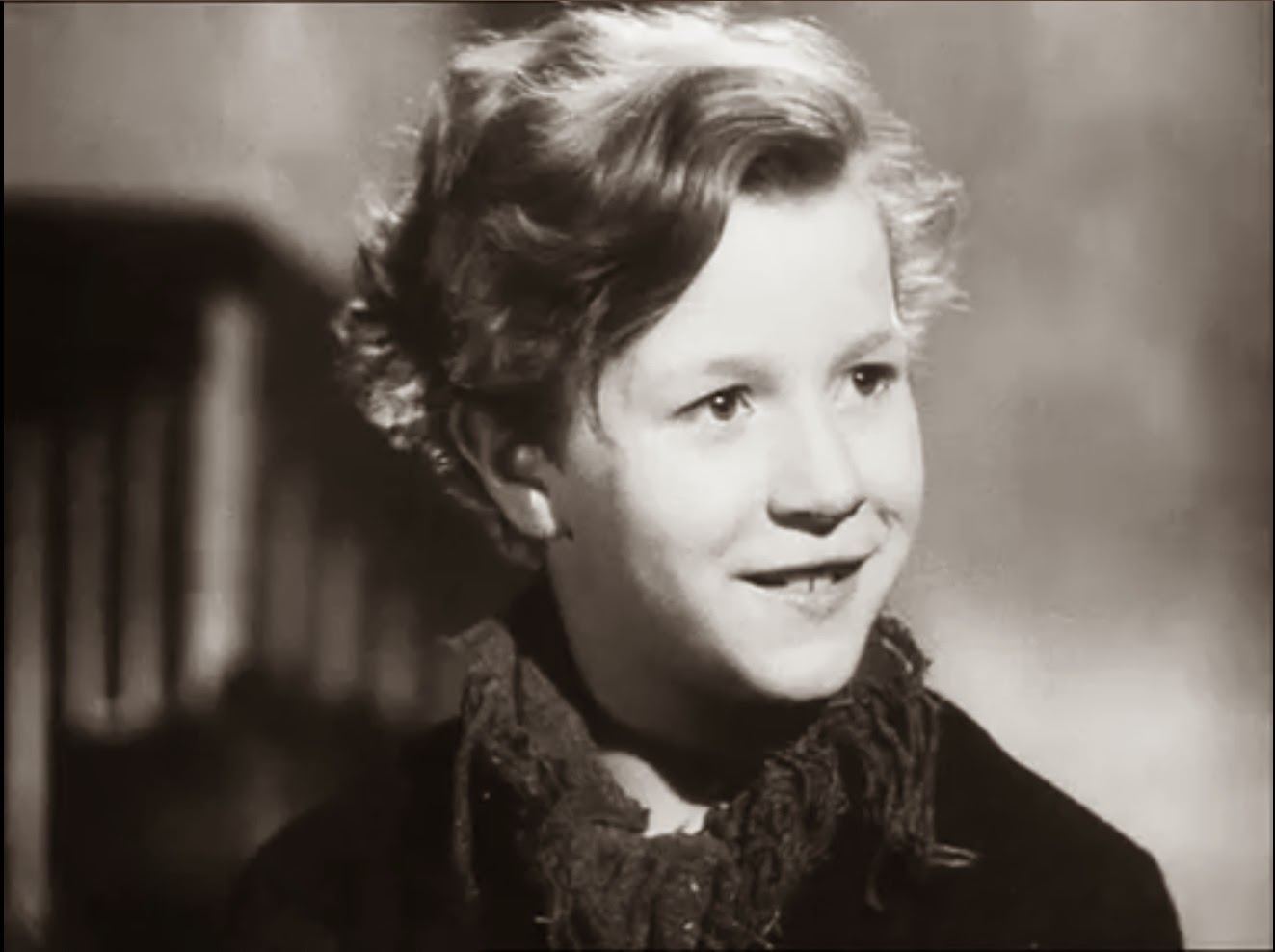
I also think this film has the Bet. Tiny Tim. Ever.   He's sympathetic and adorable without being cloying.   Kudos to Glyn Dearman for excellent delivery of The Line!  

"God bless us every one!"
This adaptation is also notable for showing up in quite a few subsequent Christmas-y films & programs -  Lethal Weapon,  2 separate episodes of The Sopranos and the "How The Ghosts Stole Christmas" episode of The X-Files to name but a few.

This version of A Christmas Carol definitely captures the "spirit" (pun intended!) of Dickens' story with aplomb and is highly recommended.

RigbyMel's rating:


4 candy canes

Monday, December 16, 2013

A Christmas Carol (1938)

Premiered 16 December 1938

In this slick MGM adaptation, directed by Edwin L. Marin and produced by Joseph L. Mankiewicz, Scrooge is played by Reginald Owen.

Reginald Owen as Scrooge, early in the film.
Lionel Barrymore (who played Scrooge on the radio for several years) was originally cast to play the old miser, but a hip injury prevented this.

Title card for the 1938 adaptation.
Barrymore does introduce the trailer for the film, watch it here:


As for other principal characters:

Bob Cratchit is played by Gene Lockhart, who has a bit of a Christmas movie pedigree.  He also plays the judge in the 1947 classic, Miracle on 34th Street.

Scrooge confronts Bob Crachit.
Scrooge's nephew Fred is played by Barry MacKay, who was best known for similar light comedic roles in British films from the 1930s.

Scrooge with Fred (Barry MacKay).
Tiny Tim here is portrayed by (Terry Kilburn), who went on to appear in Goodbye, Mr. Chips in 1939.

Here's a fun bit of trivia about the Cratchit family as portrayed in this verison:  as previously mentioned, Bob is played by Gene Lockhart.  Mrs. Cratchit is played by Kathleen Lockhart, Gene's wife, and their daughter June Lockhart (best remembered for her tv roles on  Lassie and Lost in Space) plays daughter Belinda Cratchit.
Marley's Ghost (Leo G. Carroll) appears in Scrooge's room.
Other notables include Leo G. Carroll (one of the best character actors of the 20th century) as Marley's Ghost and Ann Rutherford (who played Scarlett's sister Carreen in Gone With The Wind) as the Ghost of Christmas Past.
The Ghost Of Christmas Past (Ann Rutherford) takes Scrooge back to his old school.
As you may recall from last year's Dickensfest, we break from our usual summary/review format (since most of you know the plot of A Christmas Carol) and discuss the major differences found in various adaptations.

What's different about this adaptation?  Quite a bit.

After the opening titles, we get this image:


Most film and tv versions open in Scrooge's counting house.  This version begins with Fred joyfully walking through the snowy streets of Victorian London.  He stops and chats with some young boys playing in the snow, one of whom turns out to be a son of Bob Cratchit. 

Fred then enters Scrooge's business.  He brings Cratchit a bottle of wine to keep him warm, since Scrooge won't allow more coal to be put on the fire.

Later, Cratchit leaves for home and gets ambushed by kids having a snowball fight.  He shows them how to make a "real" snowball.  Cratchit proceeds to inadvertently throw the snowball at Scrooge and scores a direct hit.  Scrooge fires Cratchit on the spot and is mean enough to say that Bob owes him a shilling for ruining his hat.

In spite of this turn of events, Bob goes shopping for Christmas dinner anyway.  He is determined that his family shall have a nice meal even if he has lost his job.  We don't normally see Cratchit  purchasing Christmas dinner at all, much less Cratchit actually losing his situation in most adaptations. 

When Marley's ghost appears, Scrooge sticks his head out of the window and calls town criers into his house to get rid of Marley's ghost.  The ghost disappears, one of the criers says that the "intruder seems to have ex-truded" and they ask Scrooge for some "Christmas spirit" (aka alcohol). 

Scrooge's Sister Fran comes to pick him up from school; Calls him Ebbie.  Scrooge's sister in the book is named "Fan" and (as far as I can tell), there's no other adaptation where she calls Scrooge Ebbie. 

We see "adolescent" Scrooge working for Fezziwig.  The Christmas party, is omitted from this adaptation, so is Scrooge's fiancee.  


The Ghost Of Christmas Present (Lionel Braham) with Scrooge.


Next, the Ghost of Christmas Present takes Scrooge to a church.  They observe Fred and his fiancee Bess singing "O Come All Ye Faithful".  Scrooge says they should be married. 

Bob and Tiny Tim are in church too.  They bump into Fred and Bess outside, Tim says she's very pretty.  Fred and Bess decide to slide on the ice.  A Minister scolds them for sliding, then goes for a slide himself.  They slide, then kiss in public.

Tiny Tim & Bob sing at church.
The Ghost of Christmas Present and Scrooge make their usual visit to the Cratchit home.  Bob tells his daughter Martha that Scrooge fired him.  When it comes time for the Christmas toast, it's Mrs. Cratchit who toasts Scrooge.  This is a major departure from the book and most films, where Mrs. Cratchit detests the man and get's angry when Bob toasts his boss. 

Bob & Tiny Tim arrive home from church.
Scrooge's visit to Fred's house is similar to other adaptations.  But when it's time to go, Scrooge  says he wants to stay and that he "loves Christmas".  This version does NOT show us "Ignorance and Want".  

Scrooge next appears on a hill, with Ghost of Christmases Yet To Come.  This segment is consistent with most re-tellings.

When Scrooge wakes up, we get some more differences:

Scrooge personally delivers the prize turkey to Cratchit's house.  He's brought toys for the kids; Fred  and Bess are with him too.  Scrooge mentions that Fred is now his partner. 

Scrooge raises Bob's salary, offers Peter a job when he's old enough.

Scrooge toasts Christmas, Tim says The Line.

J.A. Morris says:

I have mixed feelings about this adaptation.  This was the first live-action version of A Christmas Carol that I ever watched, so I will always have a sentimental attachment to it.  For whatever reason, the local UHF stations in my area aired this much more than the 1951 adaptation that features Alistair Sim.  So Reginald Owen is "my" Scrooge.

Scrooge encounters the Ghost Of Christmases Yet To Come.
I'd say Owen is a good Scrooge, rather than a great one.  He does a decent job with the adapted script he has to work with.  And I feel that his transformation happens a little too fast.  By the end of his visit to "Christmas Present", he announces that he "loves Christmas"?  Already?  Then why bother with the last spirit?

But one problem with this film is that Scrooge seems no more important than his nephew Fred, whose role is expanded here.  The film opens with Fred, we see Fred and his fiancee at church, they play in the snow outside the church.  There were times when I thought the movie should have been called "Fred, Nephew Of Scrooge".  It seems like MGM wanted to emphasize this "young love" subplot.  I can understand, this film came out in 1938 (when the Great Depression was still going on) and they didn't want this to be too...depressing.  But it doesn't play so well today.    

Another problem is the Cratchits.  Gene Lockhart was a good character actor, and he's fine here.  But the Cratchit's home is too nice.  They have knickknacks on the shelves and pictures on their walls as well as quite a few rooms for a poor Victorian family.  

The Ghosts are all pretty good, especially Carroll as Marley.


I'll always enjoy the 1938 adaptation of A Christmas Carol  since it's the version I grew up with.  But compared to other versions, I'd say it's not so great today.

J.A. Morris' rating:


 2 and a half candy canes.


RigbyMel says:

This version of A Christmas Carol is relatively new to me.   The MGM budget makes for good production values, but there are a few too many liberties taken with the story for my taste.


As J.A. Morris says, Scrooge's conversion happens too quickly and the film's focus on nephew Fred is a bit strange.   After all,  A Christmas Carol is about Scrooge and his journey from parsimonious sinner to generous man suffused with the Christmas spirit.  Fred is there as a foil to Scrooge.   Fred's scenes sliding on the ice and smooching (in public?! -- not very good Victorian etiquette!) with Bess are cute enough but are very peripheral to the tale at hand.


This is an interesting, but not great adaptation.

RigbyMel's rating:


2 candy canes