This installment of “Oscar Takes A Holiday” looks at the animated 1971 adaptation of A Christmas Carol.
This adaptation won the Academy Award for Best Animated Short Film. A Christmas Carol was produced as an ABC TV special. It later played in theaters, which made it Oscar-eligible. This was controversial at the time and led to the Academy changing its rules to disqualify any future made-for-TV productions from being nominated.
Richard Williams produced and directed A Christmas Carol. In addition winning an Oscar for this short, he won the Best Visual Effects for Who Framed Roger Rabbit. The Academy also gave him a “Special Achievement” Oscar for For animation direction and creation of the cartoon characters for Roger Rabbit.
Chuck Jones in 1996, when he received an honorary Oscar.
J.A. Morris says:
I don’t feel the need to summarize and explain the plot of A Christmas Carol. Williams and company do a great job fitting the story 25-minute special. This adaptation touches on just about everything in Dickens’ story, though some events get only a few seconds of screentime.
Most animated adaptations of A Christmas Carol don’t include Ignorance and Want, but we see them in this special.
We also see the phantoms outside Scrooge’s window who cry because they can’t help those in need.
Williams remembers that A Christmas Carol is, at its heart, a ghost story. There are some adaptations that turn it into a treacly Victorian Christmas card. This version is legit dark, spooky and scary.
Another thing that makes this adaptation special is that Scrooge is voiced by Alastair Sim. Critics and fans generally cite Sim’s interpretation of Scrooge as the best on film and his presence adds even more gravitas to this special.
The narration is provided by Michael Redgrave, another great actor.
A Christmas Carol is beautifully animated and is a great, if short, adaptation of the quintessential Christmas story. Highly recommended.
Holiday Film Reviews presents a special guest post from Victoria Willis, a long time friend of mine and co-editor of Geek Rock: An Exploration of Music and Subculture. You can follow her as @Technopoesis on Twitter. Thanks very much, Vickie for sharing your review of The Muppet Christmas Carol! -- RigbyMel ***************************************
I have a confession to make. I had never seen The Muppets Christmas Carol prior to watching it for this blog post.
I’ve seen other versions
of A Christmas Carol. Scrooged is a particular favorite. And, of
course, I love Charles Dickens’ novella. I love that it’s one of THE
Christmas tales, and I love how it is essentially a ghost story. I love that it almost single-handedly revived (and created) traditions for a holiday that was
a lot less warmly loved prior to 1843 than it is today. I love that it embodies
Christmas spirit. And I love how it defines Christmas spirit andhow it emphasizes giving and charity and
joyousness and community and fellowship. It’s not just that Charles Dickens is
the man (cause he is), but he’s the man that’s pretty clearly against The Man,
and A Christmas Carol is a lovely introduction to Dickens’ many
works.
So, I clearly went into The
Muppets Christmas Carol with great expectations (ha ha ha). How does The
Muppets Christmas Carol hold up to such a scrumptious piece of literature?
Brilliantly.
First, in a twist,
Dickens narrates the tale, as played by Gonzo the Great, with the help of Rizzo
the Rat. They are excellent narrators, occasionally breaking the fourth wall
and engaging in hi-jinks to follow the story that they are also telling. These
are playful narrators, delighting in storytelling and stories at the same time;
a process, really, that just underscores how creativity, and storytelling,
isn't always linear.
Michael Caine is a formidable
Ebenezer Scrooge. I hesitate to say that I prefer his Scrooge to Bill Murray’s,
but I think I do. It’s a difficult role to play, Scrooge; it’s difficult to
portray the embodiment of callousness and penny pinching and heartlessness.
It’s certainly much harder to be callous and penny pinching and heartless to a
bunch of adorable Muppets. Caine’s “Humbugs” sound like what I hear when I read
Dickens.
For Kermit the Frog,
it’s not easy being mean, and he’s a fantastic Bob Crachit, gentle and kind and
courageous. Miss Piggy plays his wife, and her indignation is classic
Piggy. With Robin the Frog as Tiny Tim, it’s a dynamic foundation for the
Cratchit family, and a heart-wrenching one as well. Tiny Tim always gets me,
and it’s easy to see how Scrooge’s heart is melted by this family.
The Ghosts of Christmas
Past, Present, and Future are as weird, strange, and downright creepy as ghosts
tend to be.
The Ghost of Christmas Past is ethereal, young, and fleeting, and
the effects actually hold up pretty well.
The Ghost of Christmas Present is
stern in Dickens, but the jolly Muppets version infuses an almost Buddha
(albeit a goofy Buddha) quality to the present.
And the Ghost of Christmas
Future, who, while not a skeleton, is a cloaked figure so scary that Gonzo and
Rizzo take a break from narrating to hide, and return later, after that ghost
has departed. Each ghost does its duty, and shows Scrooge the things he needs
to see.
There are a few things
that make The Muppets Christmas Carol truly special. First, is how close
it is to the original. For the most part, it’s unswerving.
There are a couple
of tweaks, such as the addition of Jacob Marley’s brother, Robert, to allow
Statler and Waldorf to play the role(s). The Ghost of Christmas Present is
upbeat and rather goofy, which is appropriate for the age of the intended
audience. Second, surprisingly (to me, watching for the first time) is the
music, which is genuinely sing-able and charming. It’s easy to forget just how
endearing singing Muppets are, and how sing-able Muppets’ songs can be. And,
third, of course, the Muppets themselves, whose shenanigans and comedy
contribute to the story, and make it a wonderful introduction to this
traditional Christmas tale for young audiences and less young audiences alike.
The Muppets Christmas
Carol makes it easy to be a Scrooge. And by “Scrooge,” I mean, of course, a
generous, grateful, joyous, merry, kind, attentive, compassionate kind of
person. When all is said and done, what other kind of Scrooge is there?
A Grinch, on the other
hand, well, that’s another matter entirely.
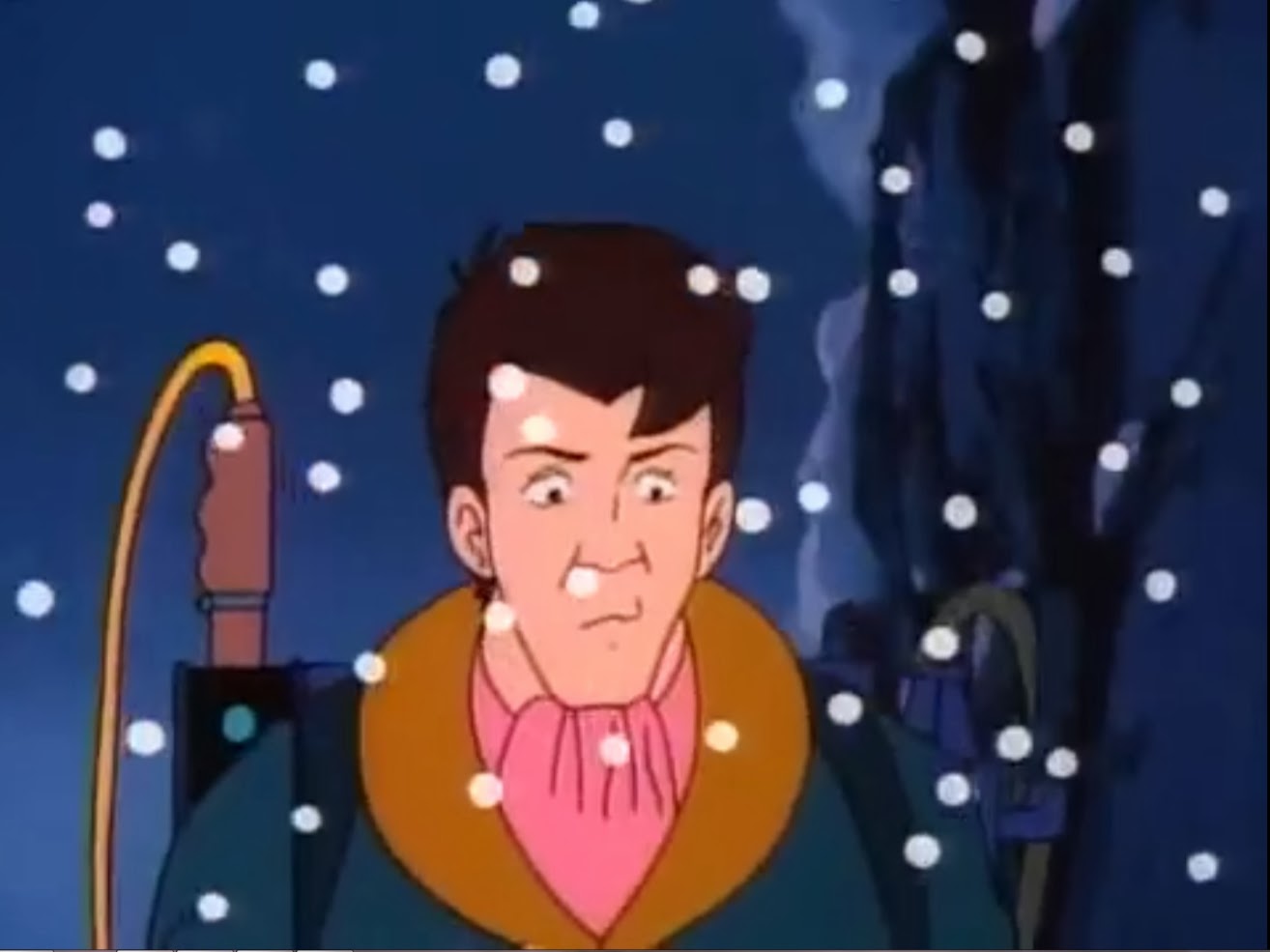
The Ghostbusters are driving around, lost in Upstate New
York, when their Ecto-1 ambulance breaks down.
Winston (Arsenio Hall), Ray (Frank Welker) and Egon (Maurice Lemarche) wish they
were home celebrating Christmas. Peter
Venkman (Lorenzo Music) scoffs at this, he’s never had any use for the holiday season. Venkman’s father
had a job that kept him that often kept him away during Christmas when he
was a kid.
They stumble on a small town
that’s not on the map. The buildings
look old and all the people are dressed in Victorian fashions.
We see a resident of the town, Bob Cratchit (LeMarche) buying a Christmas turkey.
Bob Cratchit with Tiny Tim on his shoulders.
The Ghostbusters hear ghostly noises and track them to a
nearby house.They find three ghosts
talking to an old man. The ghosts are promptly captured & trapped.
It turns out the old man was Ebenezer
Scrooge (Peter Renaday), he’s very grateful for the Ghostbusters' intervention but gets angry when they ask
for payment for their service.
The Ghostbusters threaten to release the ghosts, but he pays them with a valuable coin over a
hundred years old. The age of the coin makes the Ghostbusters curious. Scrooge decides to
declare war on Christmas.
The Ghostbusters return to New York and are shocked to see no
one celebrating Christmas.
They wish passersby a Merry Christmas only to be greeted
with “Bah Humbug”.
Scrooge's message has turned the Ghostbusters' assistant Janine (Laura Summer) against Christmas.
They learn that their upstate New York adventure somehow caused them to travel back in time to Victorian England. They realize they've accidentally changed the future.
In the anti-Christmas spirit, New Yorkers greet each other with "Bah Hambugs."
The Ghostbusters captured the Christmas Spirits before they could
teach Scrooge his lesson, and eventually Scrooge’s anti-Christmas sentiments caught
on all over the world. Scrooge authored a book called A Christmas Humbug that served as a manifesto against the holiday.The Ghostbusters
have accidentally destroyed Christmas! (Perhaps they should have remembered their Dickens.)
They hope that if they can go back in time again and
release the ghosts, everything will go back to normal. But that may not be an easy task. Egon will have to go into the containment unit and free the ghosts, which could cost him his life.
This prompts the Ghostbusters to act as substitutes for the three Spirits Of Christmas, in case Egon's efforts are not successful.
Peter stands in for the Ghost of Christmas Past.
Winston "understudies" for the Ghost of Christmas Present.
Ray poses as the Ghost of Christmas Future.
Can the Ghostbusters restore Christmas? Even if they can, will Peter Venkman continue to hate Christmas? J.A. Morris says: The Real Ghostbusters is a show I remember but I'd never seen an entire episode until I stumbled on this a couple years ago. It's a fun Christmas episode, as long as you get past a few things. For example, Scrooge is a fictional character, not a real one. And like most time-travel stories, this one has paradoxes.
This is not,strictly speaking an adaptation of A Christmas Carol, but it's a good homage. In this episode we get not one,but two Scrooges, since Peter Venkman is lacking in Christmas spirit just like Dickens' old miser. When the Ghostbusters are forced to stand-in for the Ghosts, they come up with some humorous techniques. My favorite was using a View-Master as a "magic window" that let's Scrooge see his past!
If I have any problem with this episode it's that the animation looks cheap and hasn't aged very well.
Carolers sing outside the Ghostbusters' firehouse on Christmas Eve.
But the voice actors are very good. Lorenzo Music, Frank Welker and Maurice Lemarche are big names in the voiceover world. They're good here, even if they don't sound like very much like their movie counterparts. And Arsenio Hall (years before he became famous as a talk show host) is also good as Winston.
The Ghostbusters and friends share a Christmas toast.
I can't discuss this series without mentioning Lorenzo Music. He played the voice of Garfield in Garfield And Friends. Music voices Peter Venkman here, a role played by Bill Murray in the Ghostbusters movies. In 2004 the motion picture Garfield, the cat was voiced by...Bill Murray. Life is funny sometimes!
Marley's Ghost flees Scrooge's as the Ghostbusters arrive.
"X-mas Marks The Spot" is no classic, but it was fun and exceeded my expectations. While it wasn't an adaptation, it still contained Dickens' message about treating your fellow humans with kindness at Christmas and year-round. And it was a nice introduction to the series. If nothing else, it makes me want to check out the Halloween and Thanksgiving episodes of The Real Ghostbusters. J.A. Morris' rating:
3 candy canes. RigbyMel says: I know I watched The Real Ghostbusters when it was first on (my younger brother ADORED it), but I don't remember watching this particular episode until recent years.
As J.A. Morris says, there are some clever touches to this episode, but there is also a LOT going on in it. The stumbling into an alternate time/dimension reminds me a lot of Brigadoon. The Christmas-less world that the Ghostbusters inadvertently create has a bit of an It's A Wonderful Life flavor. And, of course, there are the obvious references to A Christmas Carol throughout. The sub-plot where Egon actually goes into the ghost containment unit in search of the captured A Christmas Carol ghosts that leans heavily on the sci-fi aspects of the series. In point of fact, there seems to be a bit too much going on in this little, cheaply animated half hour episode for it to have much cohesion.
Also, when the Ghostbusters meet Bob Cratchit and Tiny Tim, it bothers the heck out of me that Tiny Tim resembles a frog more than a human child.
This is an amusing episode, but the lack of cohesiveness keeps it from being great.
Lionel Barrymore (who played Scrooge on the radio for several years) was originally cast to play the old miser, but a hip injury prevented this.
Title card for the 1938 adaptation.
Barrymore does introduce the trailer for the film, watch it here:
As for other principal characters:
Bob Cratchit is played by Gene Lockhart, who has a bit of a Christmas movie pedigree. He also plays the judge in the 1947 classic, Miracle on 34th Street.
Scrooge confronts Bob Crachit.
Scrooge's nephew Fred is played by Barry MacKay, who was best known for similar light comedic roles in British films from the 1930s.
Here's a fun bit of trivia about the Cratchit family as portrayed in this verison: as previously mentioned, Bob is played by Gene Lockhart. Mrs. Cratchit is played by Kathleen Lockhart, Gene's wife, and their daughter June Lockhart (best remembered for her tv roles on LassieandLost in Space) plays daughter Belinda Cratchit.
Marley's Ghost (Leo G. Carroll) appears in Scrooge's room.
Other notables include Leo G. Carroll (one of the best character actors of the 20th century) as Marley's Ghost and Ann Rutherford (who played Scarlett's sister Carreen in Gone With The Wind) as the Ghost of Christmas Past.
The Ghost Of Christmas Past (Ann Rutherford) takes Scrooge back to his old school.
As you may recall from last year's Dickensfest, we break from our usual summary/review format (since most of you know the plot of A Christmas Carol) and discuss the major differences found in various adaptations.
What's different about this adaptation? Quite a bit.
After the opening titles, we get this image:
Most film and tv versions open in Scrooge's counting house. This version begins with Fred joyfully walking through the snowy streets of Victorian London. He stops and chats with some young boys playing in the snow, one of whom turns out to be a son of Bob Cratchit.
Fred then enters Scrooge's business. He brings Cratchit a bottle of wine to keep him warm, since Scrooge won't allow more coal to be put on the fire.
Later, Cratchit leaves for home and gets ambushed by kids having a snowball fight. He shows them how to make a "real" snowball. Cratchit proceeds to inadvertently throw the snowball at Scrooge and scores a direct hit. Scrooge fires Cratchit on the spot and is mean enough to say that Bob owes him a shilling for ruining his hat.
In spite of this turn of events, Bob goes shopping for Christmas dinner anyway. He is determined that his family shall have a nice meal even if he has lost his job. We don't normally see Cratchit purchasing Christmas dinner at all, much less Cratchit actually losing his situation in most adaptations.
When Marley's ghost appears, Scrooge sticks his head out of the window and calls town criers into his house to get rid of Marley's ghost. The ghost disappears, one of the criers says that the "intruder seems to have ex-truded" and they ask Scrooge for some "Christmas spirit" (aka alcohol).
Scrooge's Sister Fran comes to pick him up from school; Calls him Ebbie. Scrooge's sister in the book is named "Fan" and (as far as I can tell), there's no other adaptation where she calls Scrooge Ebbie.
We see "adolescent" Scrooge working for Fezziwig. The Christmas party, is omitted from this adaptation, so is Scrooge's fiancee.
The Ghost Of Christmas Present (Lionel Braham) with Scrooge.
Next, the Ghost of Christmas Present takes Scrooge to a church. They observe Fred and his fiancee Bess singing "O Come All Ye Faithful". Scrooge says they should be married.
Bob and Tiny Tim are in church too. They bump into Fred and Bess outside, Tim says she's very pretty. Fred and Bess decide to slide on the ice. A Minister scolds them for sliding, then goes for a slide himself. They slide, then kiss in public.
Tiny Tim & Bob sing at church.
The Ghost of Christmas Present and Scrooge make their usual visit to the Cratchit home. Bob tells his daughter Martha that Scrooge fired him. When it comes time for the Christmas toast, it's Mrs. Cratchit who toasts Scrooge. This is a major departure from the book and most films, where Mrs. Cratchit detests the man and get's angry when Bob toasts his boss.
Bob & Tiny Tim arrive home from church.
Scrooge's visit to Fred's house is similar to other adaptations. But when it's time to go, Scrooge says he wants to stay and that he "loves Christmas". This version does NOT show us "Ignorance and Want".
Scrooge next appears on a hill, with Ghost of Christmases Yet To Come. This segment is consistent with most re-tellings.
When Scrooge wakes up, we get some more differences:
Scrooge personally delivers the prize turkey to Cratchit's house. He's brought toys for the kids; Fred and Bess are with him too. Scrooge mentions that Fred is now his partner.
Scrooge raises Bob's salary, offers Peter a job when he's old enough.
Scrooge toasts Christmas, Tim says The Line.
J.A. Morris says:
I have mixed feelings about this adaptation. This was the first live-action version of A Christmas Carol that I ever watched, so I will always have a sentimental attachment to it. For whatever reason, the local UHF stations in my area aired this much more than the 1951 adaptation that features Alistair Sim. So Reginald Owen is "my" Scrooge.
Scrooge encounters the Ghost Of Christmases Yet To Come.
I'd say Owen is a good Scrooge, rather than a great one. He does a decent job with the adapted script he has to work with. And I feel that his transformation happens a little too fast. By the end of his visit to "Christmas Present", he announces that he "loves Christmas"? Already? Then why bother with the last spirit?
But one problem with this film is that Scrooge seems no more important than his nephew Fred, whose role is expanded here. The film opens with Fred, we see Fred and his fiancee at church, they play in the snow outside the church. There were times when I thought the movie should have been called "Fred, Nephew Of Scrooge". It seems like MGM wanted to emphasize this "young love" subplot. I can understand, this film came out in 1938 (when the Great Depression was still going on) and they didn't want this to be too...depressing. But it doesn't play so well today.
Another problem is the Cratchits. Gene Lockhart was a good character actor, and he's fine here. But the Cratchit's home is too nice. They have knickknacks on the shelves and pictures on their walls as well as quite a few rooms for a poor Victorian family.
The Ghosts are all pretty good, especially Carroll as Marley.
I'll always enjoy the 1938 adaptation of A Christmas Carol since it's the version I grew up with. But compared to other versions, I'd say it's not so great today.
J.A. Morris' rating:
2 and a half candy canes.
RigbyMel says:
This version of A Christmas Carol is relatively new to me. The MGM budget makes for good production values, but there are a few too many liberties taken with the story for my taste.
As J.A. Morris says, Scrooge's conversion happens too quickly and the film's focus on nephew Fred is a bit strange. After all, A Christmas Carol is about Scrooge and his journey from parsimonious sinner to generous man suffused with the Christmas spirit. Fred is there as a foil to Scrooge. Fred's scenes sliding on the ice and smooching (in public?! -- not very good Victorian etiquette!) with Bess are cute enough but are very peripheral to the tale at hand.