Friday, January 24, 2014

The Man Who Came To Dinner


Premiered January 12, 1942, went into wide release on January 24.

"Christmas is Mr. Whiteside's personal property, he invented it, it belongs to him.  Tomorrow morning , very first thing, Mr. Whiteside will open each and every present and he'll raise the biggest stink you've ever seen in your life."
-Maggie Cutler


Famous (and famously acid-tongued) radio personality and man of letters Sheridan "Sherry" Whiteside (Monty Woolley) travels to Mesalia, Ohio to give a lecture.


Upon arrival, he immediately starts belittling everyone he meets.  Sherry has been invited to dine at the upper middle-class home of Daisy (Billie Burke) and Grant Stanley (Grant Mitchell).  He attempts to get out of it saying, "I simply will not sit down to dinner with midwestern barbarians, I think too highly of my digestive system."


As it happens, Whiteside slips on the front steps of the Stanley home and suffers an injury, leaving him unable to walk, but certainly able to exercise his acerbic wit.


Sherry cannot leave the Stanleys' house and threatens to sue them for a large sum of money.
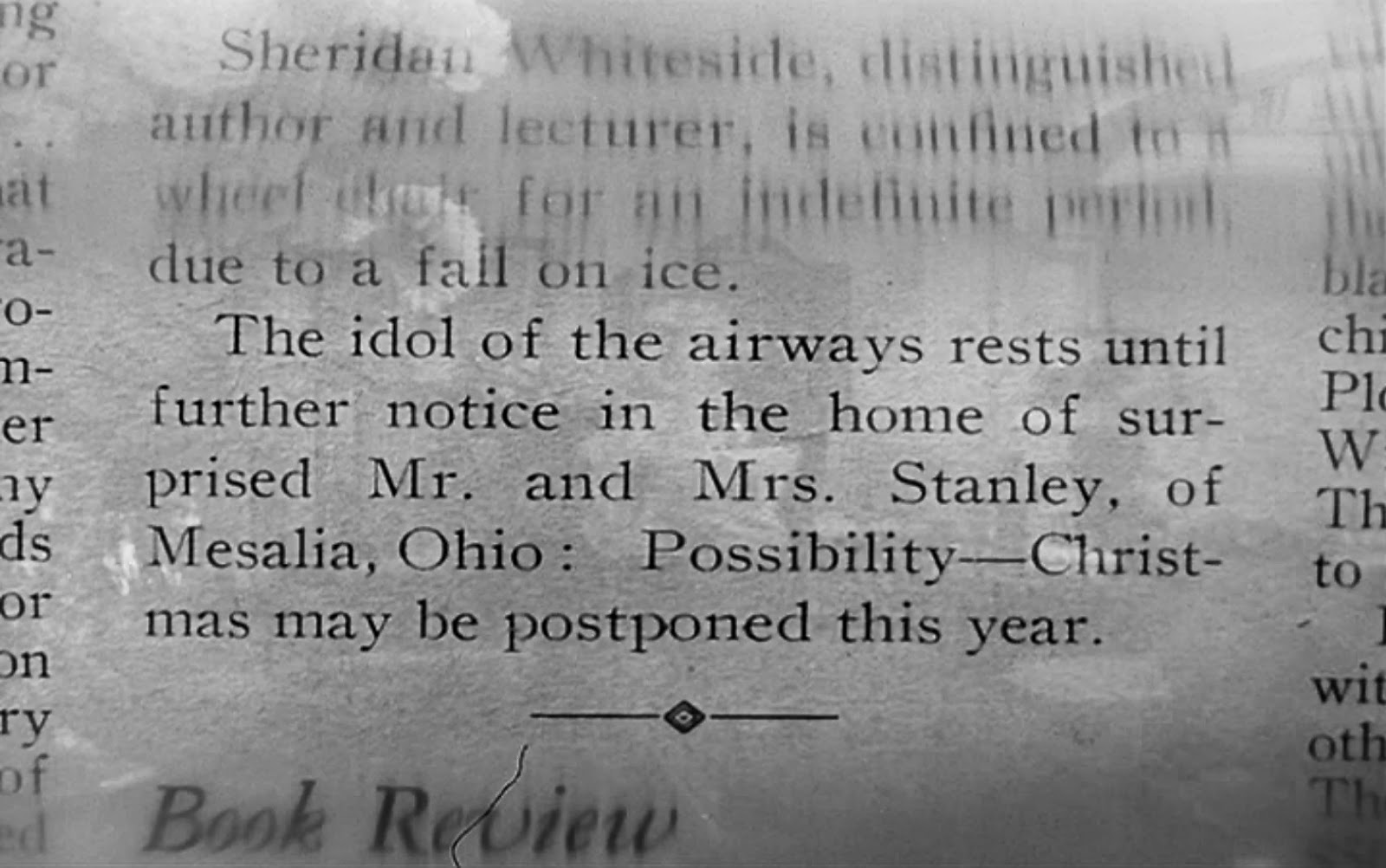
Newspaper gossip column item about Sherry's unscheduled stopover in Mesalia, OH
We also meet Whiteside's unflappable travelling secretary Maggie Cutler (Bette Davis) who has been suffering in her boss' shadow for years.  Sherry takes her for granted and denies her a life of her own.

Maggie: "When I finally leave this job, I may write a book about it ... Through the Years with Prince Charming."
Enter Bert Jefferson (Richard Travis), owner of the local newspaper who visits Sherry and requests an interview.  Bert is rebuffed by Whiteside, but he and Maggie are attracted to each other.


They spend time together ice skating and sharing hot sweet potatoes.

Maggie: "I've been skating for the first time in my life! I'm told I'm the only person to do a figure eight from the sitting position!"
Bert even reads Maggie a play he's written.  She is impressed enough with the play and with Bert that she recommends that Sherry shop it.

Bert shares his play with Maggie
In the days that follow, Sherry meddles in the affairs of the Stanleys and drives everyone crazy.


The house is constantly visited by various friends, fans and townspeople.


Whiteside continues to treat all the locals like they're idiots.  He receives telephone calls from around the world (billed to the Stanleys, of course) and assorted strange parcels and presents like a live octopus,...


 four penguins, a baby seal ...


and an Egyptian sarcophagus (!) from well-wishers.


Maggie tells Sherry that she wants to marry Bert.  Whiteside decides to sabotage Maggie's budding romance by inviting his friend, actress Lorraine Sheldon (Ann Sheridan) to Mesalia.

Lorraine and her lady's maid Cosette (Nanette Vallon)
Sherry figures she will distract Bert, thus preventing his marriage to Maggie.

Maiden Aunt Harriet Stanely
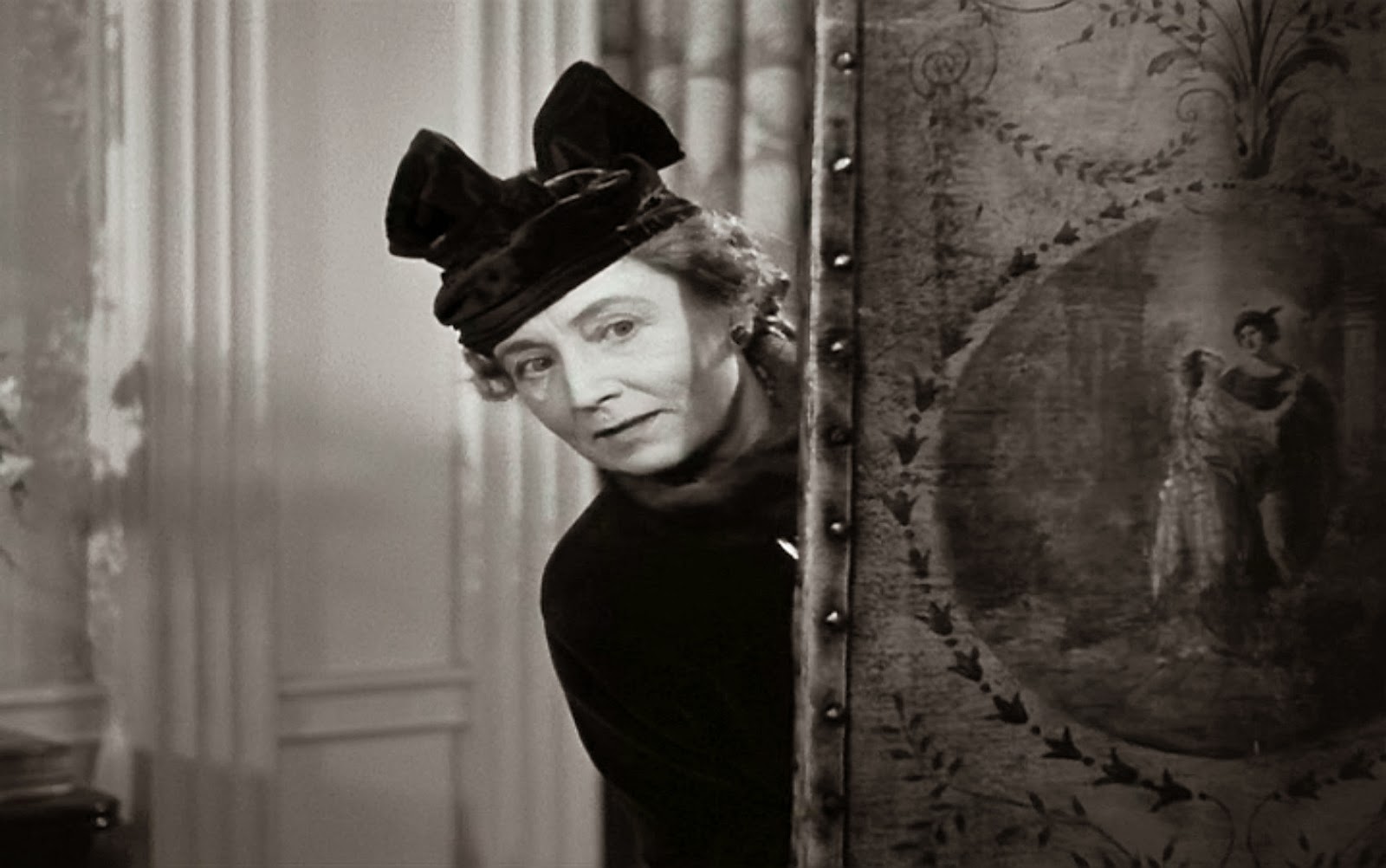
During his stay, Whiteside is visited several times by Mr. Stanley's sister Harriet (Ruth Vivian) , who seems to be a bit ... eccentric.  She is very friendly to Sherry, who thinks he recognizes her from somewhere, but can't quite place her.


Christmas arrives, and so does Sherry's friend Banjo (Jimmy Durante).


It's obvious to Banjo that Sherry is trying to break up Maggie and Bert, so Banjo tries to discourage his efforts.  But is it too late?  And what mystery lurks behind the smile of Harriet Stanley?


J.A. Morris says:
(Some minor SPOILERS below)
This is a great adaptation of a classic play.  It's written by Moss Hart and George S. Kaufman, two of the greatest playwrights of their time, and this story holds up pretty well today.  Even though it contains 1940s popular culture references, the dialogue still feels fresh.  It doesn't hurt that it was adapted for the screen by Julius and Phillip Epstein (who won an Oscar for Casablanca).

Lorraine arrives in Mesalia.
Monty Woolley (reprising his Broadway role) is great here as the imperious Mr. Whiteside.  Bette Davis was a major star in the 1940s, but she gives a great, understated performance in a supporting role.  Billie Burke (best known today for playing Glinda, the Good Witch in The Wizard Of Oz) is very funny as Whiteside's starstruck fan, remaining almost willfully oblivious to Sherry's insults.  Near the end, I worried that it was losing steam...but then Jimmy Durante shows up and nearly steals the picture from Woolley in the last act! Durante is hilarious here.


Christmas is talked about throughout the movie, but doesn't rear its head in force until the last act. We're given the impression that Whiteside exploits the holiday sentiments simply to make himself look better, while abusing everyone in sight.

Mrs. Stanley receives a call from a famous American woman.
If I have any problem, it's that Whiteside's "redemption" seems to happen very quickly.  And Bert comes off a bit dense about Lorraine's actions.  But that's a minor issue.  Maybe Whiteside's change of heart was a "Christmas Miracle"?

Banjo manhandles Nurse Preen
It should be noted, some of the characters here are based on Kaufman's friends.  Banjo's name (and behavior towards women) is based on Harpo Marx.  Whiteside is a stand-in for legendary New York theater critic Alexander Woollcott.


Two members of the cast also appear in other Christmas features:  Durante is famous among my age group for narrating the animated adaptation of Frosty The Snowman.  Mary Wickes, who plays Nurse Preen here, portrayed housekeeper Emma Allen in White Christmas.


The Man Who Came To Dinner is  highly recommended, especially for fans of classic theater.  And if you only know Durante from Frosty, this film is a great way to "discover" his talent.

J.A. Morris' rating:


Four Candy Canes!


RigbyMel says:

If you enjoy classic screwball comedies, you will enjoy The Man Who Came To Dinner.   The snappy patter works even though some references are dated and might go over the heads of a modern audience.

Sherry delivers his Christmas Eve radio commentary:"On this eve of eves, my heart is overflowing with peace and kindness".  Meanwhile, he declares war on Maggie's happiness and the citizens of  Mesalia.

Monty Woolley's portrayal of the acerbic Sheridan Whiteside is worth seeing all by itself.   However, I like that all the characters are interesting and are made more so because of the talented actors portraying them.   Jimmy Durante and Mary Wickes are standouts in supporting roles.  It's also fun to see Bette Davis in a comedic/romantic role.


For the record,  Jimmy Durante's song "Did You Ever Have The Feeling That You Wanted To Go?" was actually written by Durante himself.

"A penguin bit me!"
The Christmas setting provides an interesting backdrop for the action.

A boys' choir participates in Whiteside's Christmas radio broadcast 
The traditional peace and joy of the Christmas season is upset by Sherry's chaotic asperity.

Harriet gives Sherry a Christmas present 
Plus, there are penguins.  Penguins!

Penguins!
It is also interesting to note that Monty Woolley has another Christmas film in his list of credits,  he plays Professor Wutheridge in the 1947 film The Bishop's Wife.

Spoiled actress Lorraine Sheldon explores a possible new role
The Man Who Came To Dinner was a popular hit on Broadway in 1939 and you can spot its roots in that most of the action takes place in a single room.   The dialogue is so sharp and funny that this is not really a problem, though.

Banjo adds his hat to the Christmas decorations
The film seems to have been viewed positively when it was released in 1942, but has been, I think, a bit forgotten in recent years.   It's well worth seeing!

RigbyMel's rating:


3 and a half candy canes

Thursday, January 23, 2014

A special announcement from Holiday Film Reviews

Christmas movies have been a staple of the holiday season for almost as long as the film industry has existed.  From the 1910 silent adaptation of A Christmas Carol, to White Christmas to Fred Claus, the majority of Christmas films have been released in November or December.


But some were released out of season, including some perennial holiday staples and some modern "classics".


For example, did you know Miracle On 34th Street was released in May?  Christmas In Connecticut  premiered in August.  The song "Silver Bells" was written for The Lemon Drop Kid, but that film was released in the Spring of 1951.  


Starting tomorrow, we will occasionally review holiday movies on the anniversary of their original release date.  We don't plan to blog about Christmas programming year round, but we would like to post more content here.  This seemed like a good way to do that.

Released January 12, 1940.

So stop by tomorrow and read out first "out of season" Christmas review!


Wednesday, January 1, 2014

Maude: "Nostalgia Party"


Premiered December 30, 1974.

"This is going to be a fabulous party, the most fantastic party ever!  I mean I guarantee you this is not going to be one of those typical New Year's Eve disasters, where all the guests sit around waiting for Guy Lombardo to come on while two drunks throw up in their paper hats."
-Maude Findlay


Maude tells Mrs. Naugatuck about her party plans.
Dateline:December 31, 1974: Maude Findlay (Bea Arthur) is excitedly planning her New Year's Eve party.  She hopes it will be the greatest party of all time.  Maude says it will have what other parties don't: a scavenger hunt!  She will hide "little gifties" all over the house, and whoever finds the most "gifties" wins a prize.

Mrs. Naugatuck says it feels more like Labor Day than New Year's Eve to her!
Mrs. Nugatuck (Hermione Baddeley), the housekeeper,  is unimpressed with the plans.
Especially since the party means that she has to work on New Year's Eve.

Maude is undeterred, but her enthusiasm is dampened when her friends Vivian (Rue McClanahan) and Arthur (Conrad Bain) say they just attended a "scavenger hunt" party the night before.  Maude is convinced her party is ruined.  She gets angry when she learns that Vivian invited Estelle and Herman Ellinger, a couple who always have arguments and ruin everyone else's good time, to her party.


No one feels like celebrating 1974, Maude's friends and family are in a cranky mood.   They all agree it was an all-around bad year.  Maude's husband Walter (Bill Macy) has had a tough year running his business.  Inflation has hurt his appliance shop and Walter doesn't see that improving in 1975.

In this atmosphere, Arthur suggests they celebrate their favorite years instead of the current one.  Maude likes this idea and tells everyone to come to her party dressed as their "most nostalgic year".

Guests in nostalgic outfits of various eras
Vivian arrives dressed in a Shirley Temple outfit as if she was 5 years old (and her father's favorite child).  Her husband Arthur is 1952, the year he attended the convention where Dwight Eisenhower was nominated.

Walter does a Groucho Marx impression in uniform
Walter puts on his old Army uniform.  He says 1942 was a great year for him.

"That long-stemmed American beauty, Gypsy Rose Findlay!"
Maude tops them all. She reenacts her 1945 College Freshman Review performance, wearing what can best be described as lingerie and performs a burlesque dance for her guests!

The Ellingers arrive along with 90 something year old Aunt Polly (Judith Lowry).   The couple immediately get into a fight with each other and depart, leaving Aunt Polly behind.

The bickering Ellingers with Aunt Polly caught in the middle
As it turns out, the nostalgia angle leads to more arguments.  Maude and Arthur point out that Walter's favorite year was "great for Hitler, Moussolini,  and Hirohito".  Maude tells Arthur that '52 was a terrible year, with a recession and conflicts in the Middle East.  Vivian says Maude was "the campus zit queen" during 1945.

Aunt Polly breaks up the argument by blowing a noisemaker to get everyone's attention
Aunt Polly puts things in perspective and proposes a toast to her favorite minute, saying,  "Last year isn't important, it's what's happening now."   This causes everyone at the party to rethink their bickering and have a more positive approach.

J.A. Morris says:

There are not that many "New Year's" themed episodes.  And that's because there aren't many stories that can be told about Christmas' lesser sibling (plus, most series are on hiatus during the Christmas holidays).  But this episode makes good use of the New Year's Eve setting.  It's a typical episode of Maude, but that's not a bad thing.  Everyone has some good one-liners.  Maude gets in some zingers at Arthur, her political nemesis.  Mrs. Naugatuck points out Maude's classism.  Vivian says something slightly airheaded.

Vivian's childish behavior makes Maude want to throw up in a party hat!
 Bea Arthur deserves kudos for dancing around in a showgirl outfit.  It's something rarely done on tv (then or now) by a woman in her 50s, and she sells it!


I really like the idea of a party where guests dress as their favorite year.  Of course it helps when you have a sitcom's costume department to help you.  But the message here about living in the now and not romanticizing the past is a good one.

Arthur chants "I like Ike", the slogan for Eisenhower's 1952 campaign.
"Nostalgia Party" is a very good episode with plenty of laughs and some nice philosophy thrown in for good measure.

J.A. Morris' rating:


3 and a half champagne flutes.


RigbyMel says:

I really enjoyed this episode, which was new to me this past year.  (I've been watching quite a few episodes of Maude on the Antenna TV network recently.)

Mrs. Naugatuck winking
The nostalgia party idea is a really fun one,  and I like that this episode humorously points out that the "good old days" depend largely on point of view.    I also like that Aunt Polly, a feisty older lady,  puts all the bickering in perspective by suggesting that taking pleasure in "now" is a very important part of life.   That's a good message to ponder most days (not just New Year's Eve/Day).

Maude and Walter share a New Year's Eve kiss
This episode can be found on Maude:The Complete Series DVD set.  The series also currently airs on the Antenna TV Network  and is well worth checking out!

RigbyMel's rating:


3 and a half champagne flutes

Tuesday, December 31, 2013

Doctor Who: "The Unquiet Dead"


"On and on I go, same old show.  I'm like a ghost, condemned to repeat myself through all eternity."  - Charles Dickens (as played by Simon Callow)

Premiered April 9, 2005

For those interested in the wibbly-wobbly timey-wimey aspects of such things, this is the third episode of the 2005 re-boot of Doctor Who. 


The Doctor (Christopher Eccleston) and his companion, Rose (Billie Piper) take their first journey back in time together, traveling to Cardiff, Wales on Christmas Eve 1869.  Charles Dickens (Simon Callow) is in town to perform a dramatic reading of A Christmas Carol before a packed house of spectators.

One of these things is not like the others, one of these things just doesn't belong ... 
Dickens is in a melancholy mood, feeling estranged from his family and as if his joy in living is wearing thin.


Strange happenings are afoot at a local funeral parlor, where corpses seem to be coming to life and are wandering around Cardiff, creating more corpses in their wake.  The undertaker, Gabriel Sneed (Alan David), wants to cover up the fact that the reanimated dead seem to be emanating from his establishment on the grounds that people knowing about it would be bad for business.


Sneed's maidservant Gwyneth (Eve Myles) wants to get help for their zombiefied corpse problem, but Sneed insists on taking care of it himself.   Gwyneth has clairvoyant abilities, about which she feels somewhat ambivalent, and Sneed has been using her skills to track down the wandering corpses.   The wandering corpse in question at this juncture belongs to an elderly woman who has just strangled her grandson as he leaned over her coffin to pay his last respects.


Gwyneth focuses on the old woman's last desire, which was to see Mr. Dickens' reading, so she and Sneed wind up at the reading around the same time as the Doctor and Rose.


All heck breaks loose as something ghostlike, gaseous and loud hisses forth from the reanimated old woman, who is seated in the middle of the audience at the reading.


The Doctor is (naturally) fascinated.  The audience is scared out of its wits.  Mr. Dickens is perplexed and thinks this must be some kind of a trick.   Rose is in the wrong place at the wrong time.  She gets chloroformed by Mr. Sneed and dragged back to the funeral parlor.


The Doctor enlists Charles Dickens' aid (and carriage) to go rescue Rose.


Solving the mystery of the "Unquiet Dead" will require a seance and considerable courage.


Will everyone survive the experience?   Will Charles Dickens locate his Christmas spirit and zest for living?


RigbyMel says:

Full disclosure,  Charles Dickens is one of my favorite authors and Doctor Who is one of my favorite tv series, the combination of the two is somewhat hard to resist where I am concerned.

I quite like the characterization of Charles Dickens by Simon Callow in this episode.


Dickens doesn't often appear as a character in tv or film, but it is worth noting that he has been played by Simon Callow on several different occasions other than this episode.  (Callow has also written extensively about Dickens and performed a one man show as Dickens, so one thinks he might have a pretty good handle on how to play him.)

Dickens was a clever chap and although he is definitely confused by and skeptical about the bizarre situation in which he finds himself (who wouldn't be?)  He manages to deal with it fairly well and actually helps to save the day when the Doctor and Rose get trapped.

The Doctor:  "I saw the Fall of Troy!  World War Five! I pushed boxes at the Boston Tea Party!  Now I'm gonna die in a dungeon ... in Cardiff!" 
This episode early in the re-boot of the series harks back to the educational aspects of Doctor Who that have always been present on the show.  Meeting historical figures is a favorite trope and Dickens' state of mind at the beginning of the episode tallies well with his actual biography.


There are bits of Ebenezer Scrooge evident in the world-weary Dickens we encounter at the beginning of the episode and also some fun parallels with Dickens' idealism as a writer and the Doctor's desire to save the world (literally) again and again.


After Mr. Dickens' encounter with some Christmas "spirits" and the Doctor, he is ready to reconcile with his family and "keep Christmas in his heart."  We even get a "God bless us, every one!" by the end of the episode.  

Speaking as a history geek, I also really love the interplay between the Victorian characters, the Doctor and Rose.  Gwyneth and Rose have a nice moment together in the scullery talking about boys and being a bit weirded out by their different approaches to proper deportment.   The Doctor manages to completely confuse Dickens when he says he is Dickens' "number one fan."  Dickens asks how the Doctor is like a device used for cooling oneself.    Shades of Christmas Past meeting Christmas Yet To Come, perhaps?

I would also like to point out that Gwyneth is a classic Dickensian orphan character in a heroic vein!

I do have a minor complaint about the ending seeming overly rushed, but don't want to go into detail as it might spoil the episode for those who have not seen it.

That being said, this is a wonderfully creepy and fun episode of Doctor Who and one of many great episodes of the series with Christmas themes and settings.

RigbyMel's rating:


3 and a half Candy Canes.


J.A. Morris says:

Like my co-blogger,I'm a huge Dickens fan, and Christopher Eccleston is my favorite Doctor.  Since this was the third episode of the Doctor Who revival, it played a big role in making me a devoted fan of the series.  With annual Christmas specials, the Doctor has become as much a part of Christmas as Rudolph and Charlie Brown.  But this was the first of his holiday-themed adventures and it first aired as a regular episode (in April).


In addition to the main plot, "The Unquiet Dead" marks an important evolution for Rose. She confronts the Doctor at one point when he wants to allow the Gelth to inhabit dead bodies.  Rose thinks it's indecent, the Doctor points out that they are dealing in a different morality with different values. She must get used to it if she wants to be his travelling companion.  However, Rose's concerns are justified in this instance.


One note about the cast:
Gwyneth is portrayed by Eve Myles, who later played Gwen Cooper on the series Torchwood, a spinoff of Doctor Who.  The series' creative team has said that Gwyneth and Gwen are "related" due to "Spacial Genetic Multiplicity."


"The Unquiet Dead" is one of my favorite episodes of the series and I enjoy watching it every Christmas season.  I highly recommend it to fans of Dickens and any Whovians who may not have discovered the series prior to the David Tennant or Matt Smith eras.


J.A. Morris' rating:


4 Candy Canes!